It goes without saying that the ease of learning a new language can depend on the languages you know already – For example, Russian speakers have an easier time with Spanish rolled-R compared to English speakers, but English speakers have an easier time with Spanish writing compared to Russian speakers due to similarities in alphabet. And in your own life, you might know (or be!) the Spanish speaker who breezed through verb conjugations in French class while your non-Romance-language-speaking classmates struggled.
As a Mandarin speaker, I thought my four-tone language would serve as an advantage in learning the six tones of Cantonese1. Also, Cantonese and Mandarin are related, so I thought I’d have a leg up over other learners (although they are not mutually intelligible2).
Well, it turns out that already speaking a tonal language did not make Cantonese tones easier – and there’s science to back that up.
The Tea: Studies suggest that knowing a tonal language doesn’t necessarily help you learn the tones of a new tonal language.
In other words, when telling apart Cantonese tones, evidence suggests a monolingual Mandarin speaker isn’t having more luck than a monolingual English, German, or French speaker – and even after extensive training. Sounds unbelievable, right?
But first thing’s first: What’s a tone/tonal language?
(You can skip this part if you know what a tone language is already.)
A language is tonal, or a tone language, if pitch changes lexical meaning and not just mood or social use. In English, if I say “Cake?” in a rising tone, that does mean something different than “Cake!” – but the fact that we’re talking about a spongey dessert doesn’t change. Therefore, English is not a tone language. In the case of Mandarin, tones are as statistically important as vowels (Surendran & Levow, 2004), so saying “ma” (high tone) and “ma” (falling tone) in Mandarin is like saying “mat” and “met” in English: they are totally different words despite a discrete acoustic difference.
Here’s another one:
- Chou (high tone) 瘳 = heal
- Chou (rising tone) 愁 = anxious, worry
- Chou (falling-rising tone) 丑 = ugly
- Chou (falling tone) 臭 = stinky
Additionally, tonal languages are not rare or exotic, accounting for over 60% of all spoken languages spoken by over 50% of the world’s population (Yip, 2002). Languages smaller than Tlingit (50 speakers, mainly in Northwestern Canada and Alaska) and as large as Mandarin Chinese (over a billion speakers) are tonal.
What do the psycholinguistic studies say on tone language speakers learning new tone languages?
Learning tone is like learning other features in a language: if a similar or same contrast exists in your native language, you generally struggle less with it. For example, English speakers generally don’t struggle with /r/ versus /l/ across other languages, but they struggle with contrasts like the three-way Korean consonant distinction (plain vs. tense vs. aspirated consonants) (Shin, 2001).
Another one native American English speakers struggle with is the vowel in the French word “tu” /y/ vs. the vowel in “tout” /u/ – and studies suggest that even speakers who’ve studied French for years struggle (Levy 2008; Levy & Strange, 2009). Take a look at the acoustics to see what I mean:
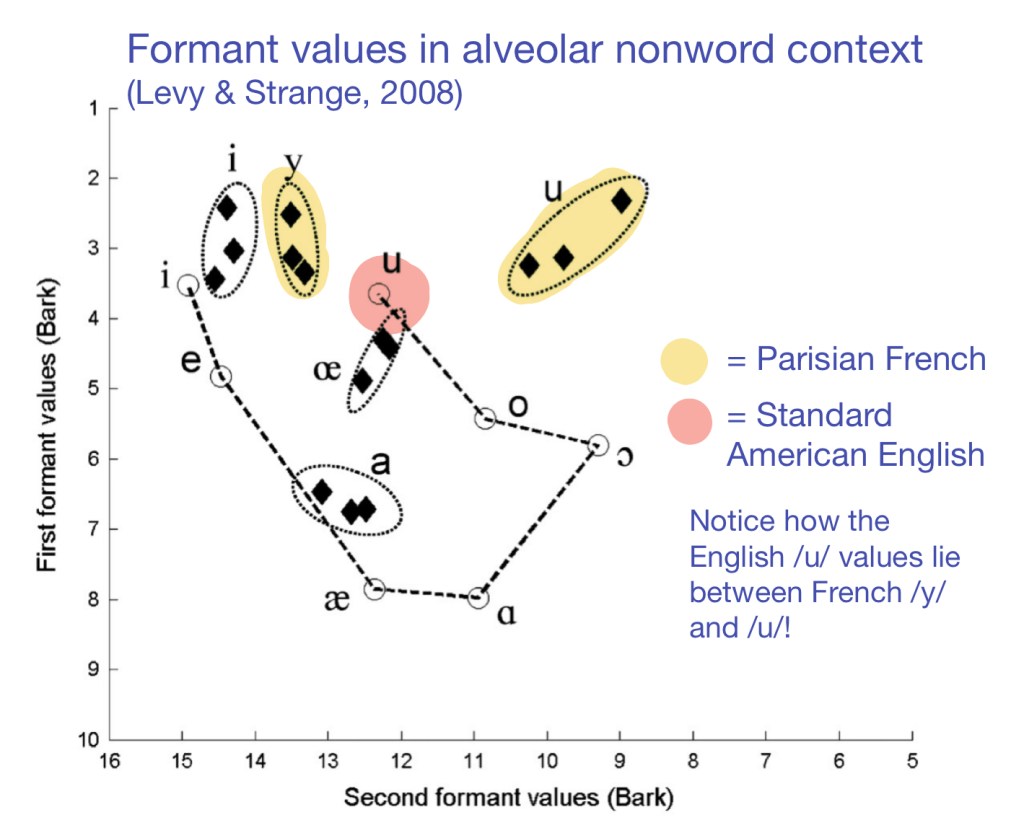
To read this graph, think of the x-axis as a measure of how advanced the tongue is, while the y-axis is how high the tongue is. You can see that the Standard American English /u/ as in “tulip” lies between Parisian French /u/ as in “tout” and /y/ as in “tu”! So, it’s not just that /y/ doesn’t exist in English that gives speakers trouble – they’re also so acoustically similar to /u/ that they fit into the same “/u/-shaped box” for English speakers! The term for this is perceptual assimilation3, the idea that non-native contrasts can get “assimilated” into one sound for non-native speakers.
Now, let’s apply the concept of perceptual assimilation to Cantonese tones. Here is a chart of the average values of the six tones (Hong Kong dialect), graphed as pitch over time:
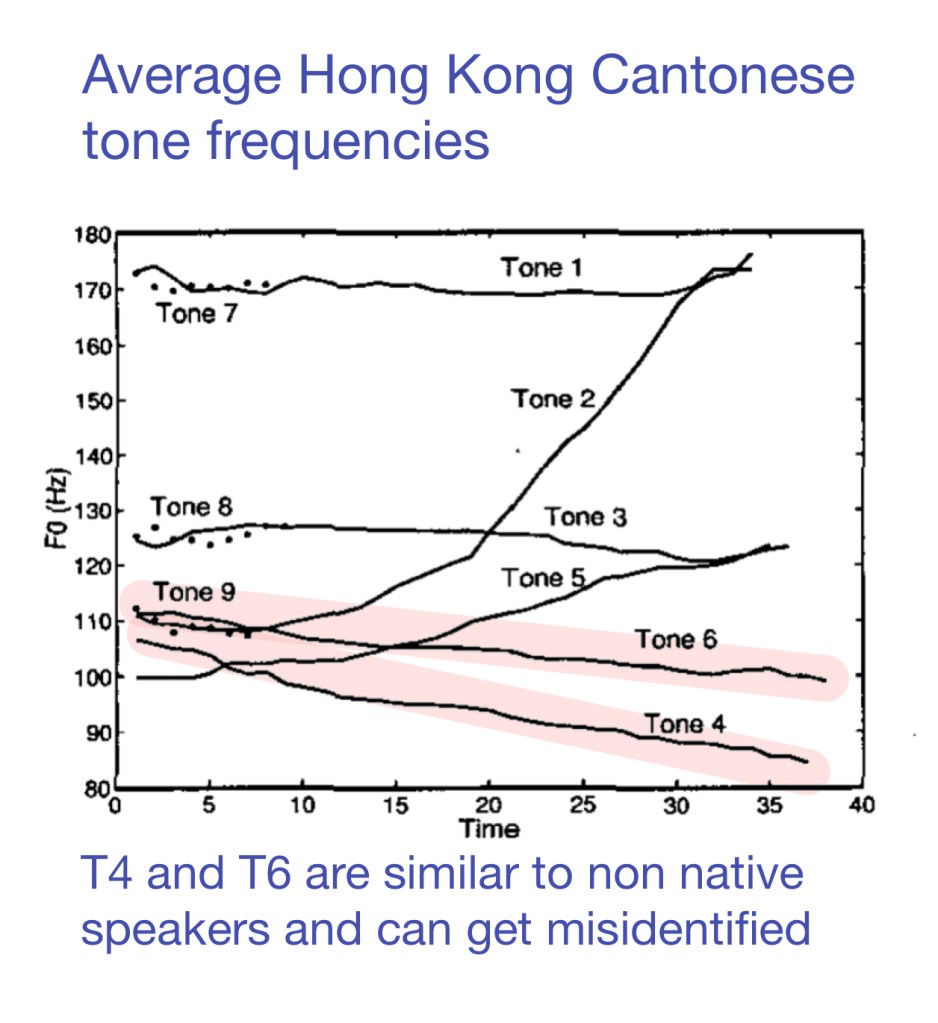
Notice that T4 and T6 start at similar places and go a little down, while T3 starts at a slightly higher position stays neutral. You can see why these three can be particularly challenging to distinguish from one another and get “assimilated”.
Now let’s put them side-by-side with Mandarin tones:
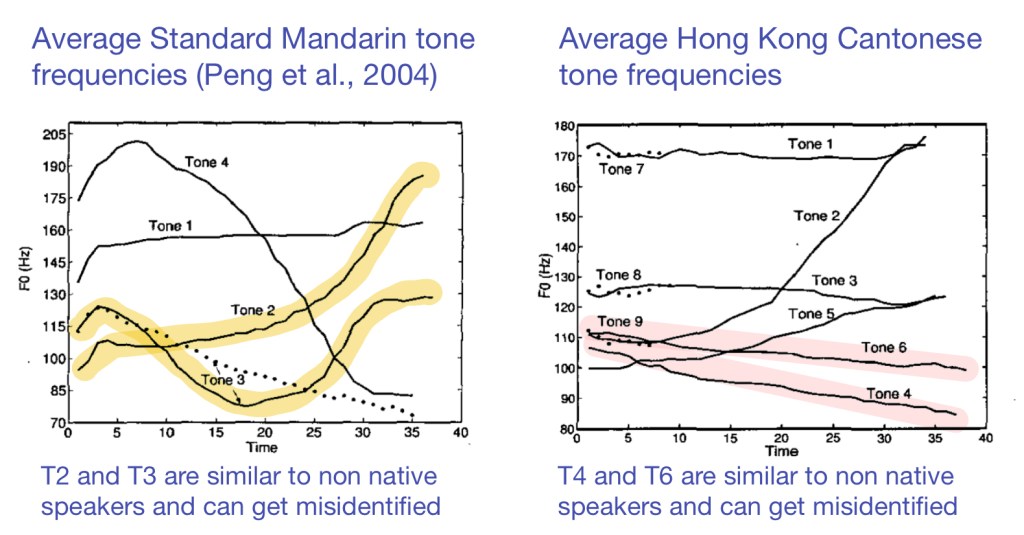
What should instantly jump out at you is that T1 and T2 in Mandarin are like Cantonese, but Mandarin T3 and T4 don’t quite match up to anything in Cantonese. So as a Mandarin speaker, I’m mixing up a lot of the lower tones (T4, T6) because 1) those contrasts doesn’t exist in the Mandarin tone inventory, and 2) they are all so alike to my non-native ears that I’m putting them into the same “box”. But on the other hand, you can see how Cantonese speakers can have the same struggles when learning Mandarin tones, as none of their tones quite resemble Mandarin T3 and T4.
Now that you see the rationale, let’s look at the evidence.
In a 2008 study, Francis et al. recruited 9 native Mandarin Chinese, 10 native English, and 12 native Cantonese speakers for a series of tone discrimination and identification tasks. After the pre-test, they were given 10 hours’ worth of training sessions spread throughout several weeks. After the series of training sessions, they were then given a post-test to assess learning of Cantonese tones:
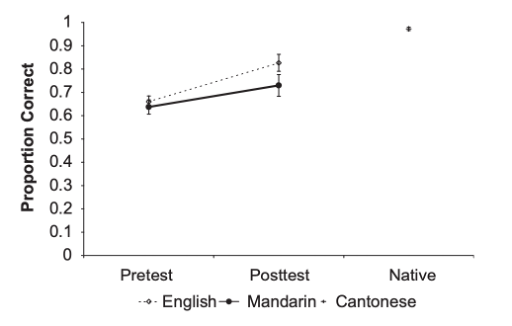
As you can see, English- and Mandarin-speaking participants scored 66% and 64% accuracy respectively in the pre-test, and 83% and 73% respectively in the post-test. Meanwhile, native Cantonese speakers (unsurprisingly) scored 97%. Statistical analyses revealed that English- and Mandarin-speakers performed similarly in the pre-test and post-test, but that the patterns of errors were significantly different. Surprisingly, T1, T2, and T3 gave neither group much trouble in the pre-test; however, T4, T5, and T6 were frequently misidentified, and only Mandarin speakers did not perform better on T5 even after training. This is probably due to assimilation of this tone to Mandarin T2, which also takes on a rising pattern. Additionally, authors speculated that Mandarin tone differentiation hinges more heavily on direction of the tone compared to the starting frequency. In Cantonese, there are two rising, one falling, and three flat tones – meanwhile, Mandarin has only one of each: flat, rising, falling-rising, and falling.
Meanwhile, Yen-Chen Hao’s 2012 study involved an opposite condition: 9 Cantonese-speaking and 10 English-speaking college students had to identify, imitate, and read out Mandarin tones, and both groups performed similarly throughout the tasks – although in this study, participants from both groups had some Mandarin-learning experience (M = 2.68 years, SD = 1.91). Again, Cantonese- and English-speaking groups performed similarly but had different patterns of errors. Namely, the Cantonese group struggled more with Mandarin T1 vs. T4. Hao’s study also had an interesting follow-up experiment: Cantonese speakers had to identify a Cantonese syllable most perceptually similar to each presented Mandarin syllable. Interestingly, both Mandarin T4 and T1 were frequently mapped with Cantonese T1 (81% and 66% of the time respectively), which may explain why they had more errors in differentiating these two tones compared to English speakers in the first experiment.
All in all, it seems like speaking Mandarin can be a hindrance to learning Cantonese tones, and vice versa.
But for what it’s worth, tonal language speakers do process pitch differently than non-tone language speakers, but that’s a conversation for a different day.
If you’re interested in reading about it, take a peek at these papers on how tone language speakers may have an advantage in discriminating and imitating musical pitch and how tone language speakers and musicians may be better at talker identification tasks.
All in all, the tone system of any language is as unique as any of its other phonological aspects, so it is impossible to create a single set of principles of acquisition that will apply across all tonal languages. So while Cantonese tones may intersect with Mandarin tones to a degree, that creates just as much confusion as benefit.
Ultimately, languages you know already definitely help you learn another one – just not in all the ways you anticipate.
The big lesson here is that supposedly helpful features end up not as helpful as you thought – but you shouldn’t feel too bummed out that your native language is messing with your brain and preventing your brain from picking up a new one! For every debunked commonality, there are unexpected and delightful commonalities between your target language and familiar language that are discovered along the way in the journey of language-learning. For instance, although Mandarin didn’t help me with Cantonese tones as much as I hoped, the parallels between the two languages in writing system, vocabulary, and grammar have been undeniably helpful – and often in unexpected ways.
-qiy ❤
References
Francis, A. L., Ciocca, V., Ma, L., & Fenn, K. (2008). Perceptual learning of Cantonese lexical tones by tone and non-tone language speakers. Journal of Phonetics, 36(2), 268-294.
Hao, Y. C. (2012). Second language acquisition of Mandarin Chinese tones by tonal and non-tonal language speakers. Journal of phonetics, 40(2), 269-279.
Levy, E. S., & Strange, W. (2008). Perception of French vowels by American English adults with and without French language experience. Journal of phonetics, 36(1), 141-157.
Levy, E. S. (2009). On the assimilation-discrimination relationship in American English adults’ French vowel learning. The Journal of the Acoustical Society of America, 126(5), 2670-2682.
Peng, G., Zheng, H., & Wang, W. Y. (2004, December). Tone recognition for Chinese speech: A comparative study of Mandarin and Cantonese. In 2004 International Symposium on Chinese Spoken Language Processing (pp. 233-236). IEEE.
Shin, S. J. (2001). Cross-language speech perception in adults: Discrimination of Korean voiceless stops by English speakers.
Surendran, D., & Levow, G. A. (2004). The functional load of tone in Mandarin is as high as that of vowels. In Speech prosody 2004, International Conference.
Yip, M. (2002). Tone. Cambridge: Cambridge University Press. doi: 10.1017/CBO9781139164559
- Yes, I know many claim there are more than four tones in Mandarin and more than six tones in Cantonese – but for simplicity’s sake, I will go with the values and dialects used by the studies I cite, which are four (ignoring the neutral tone) in Standardized Mandarin and six in Hong Kong Cantonese. ↩︎
- Obligatory note on Cantonese vs. Mandarin:Cantonese and Mandarin are part of different subfamilies. Although they’re part of the larger Sinitic (Chinese) language family, saying they’re “dialects” of Chinese is like saying Dutch and English are “dialects of Germanic” – or that French and Italian are “dialects of Romance.” Some native speakers will insist on Chinese languages being dialects, but from a classification standpoint and when applying the mutual intelligibility rule, my personal stance is that it makes more sense to call them separate languages. ↩︎
- I’m not referring to Best’s Perpetual Assimilation Model (PAM), as that’s a whole other can of worms. It’s definitely worth reading up on, though! ↩︎
 qiy's linguistics world
Leave a comment