For part 1, see here
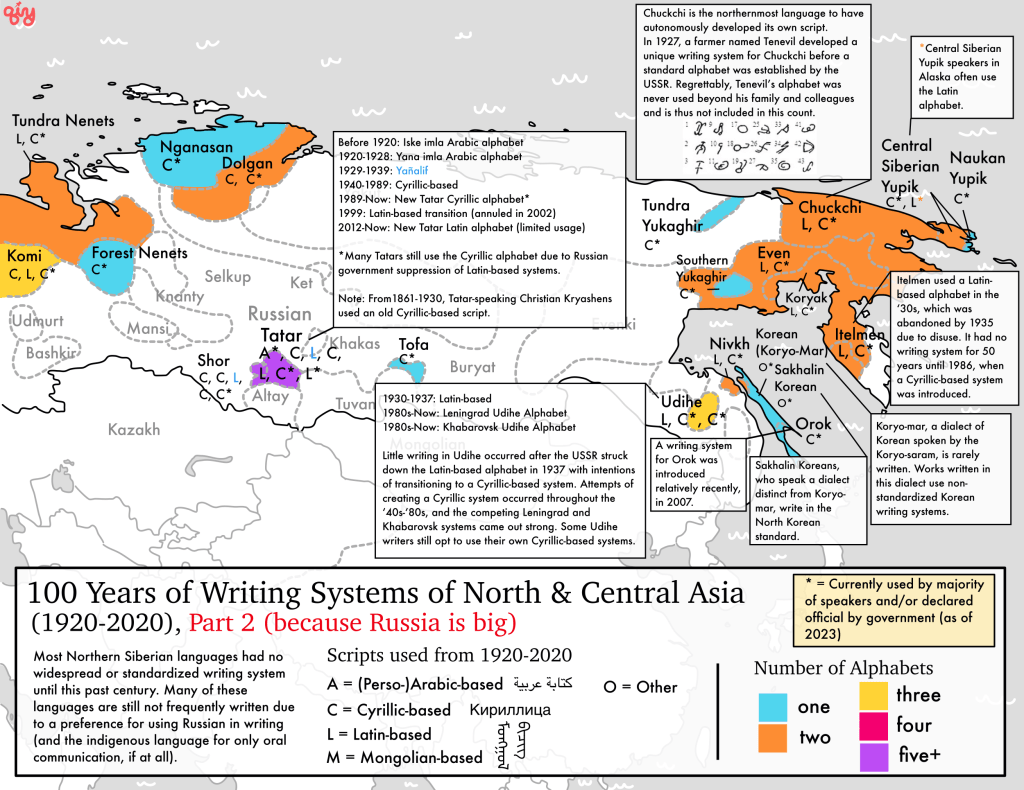
This past month, I’ve been reading The Last Speakers by K. David Harrison, incidentally a book that features several moribund and endangered Siberian languages featured in this map. In the book, Harrison sheds light on underdocumented languages like Tofa, Tuvan, and Chulym, and made harrowing observations about the speakers’ destitute living conditions. Harrison particularly did field work with the Tuvan, an ethnic group primarily residing in parts of Siberia around the northern border of Mongolia. In Harrison’s words: “Tuvans live as a minority people, poor, persecuted, forgotten, at the margins of a once great empire ‘Russia’ which regards them as backward, inferior social parasites.” Today, nearly 15 years after Harrison’s book was published, the presence of Siberian languages have dwindled even further. The languages depicted in this map are particularly in danger, as they are primarily spoken in remote regions (In fact, I heard that “Kamchatka” is an expression for “a far away place” in Russian). Most of them are rarely written or even spoken. For languages like Ket and Orok, where an alphabet was introduced relatively recently, I could find no evidence for its few remaining speakers using a written form. In the cases of larger languages like Tatar (5 million speakers) spoken by ethnic Volga Tatars, there has been a fight against the Russian government to allow a Latin-based alphabet. The fight is still ongoing.
In drawing this map and the map from part 1, I realized that the main lesson is not one of orthographic history as I intended, but one of oppression and ethnolinguistic conflict. I hope you take a moment to learn about these languages and the complex history of their writing systems under USSR and Russian Republic rule.
-qiy
References: http://u.pc.cd/rNAitalK
 qiy's linguistics world

Leave a comment