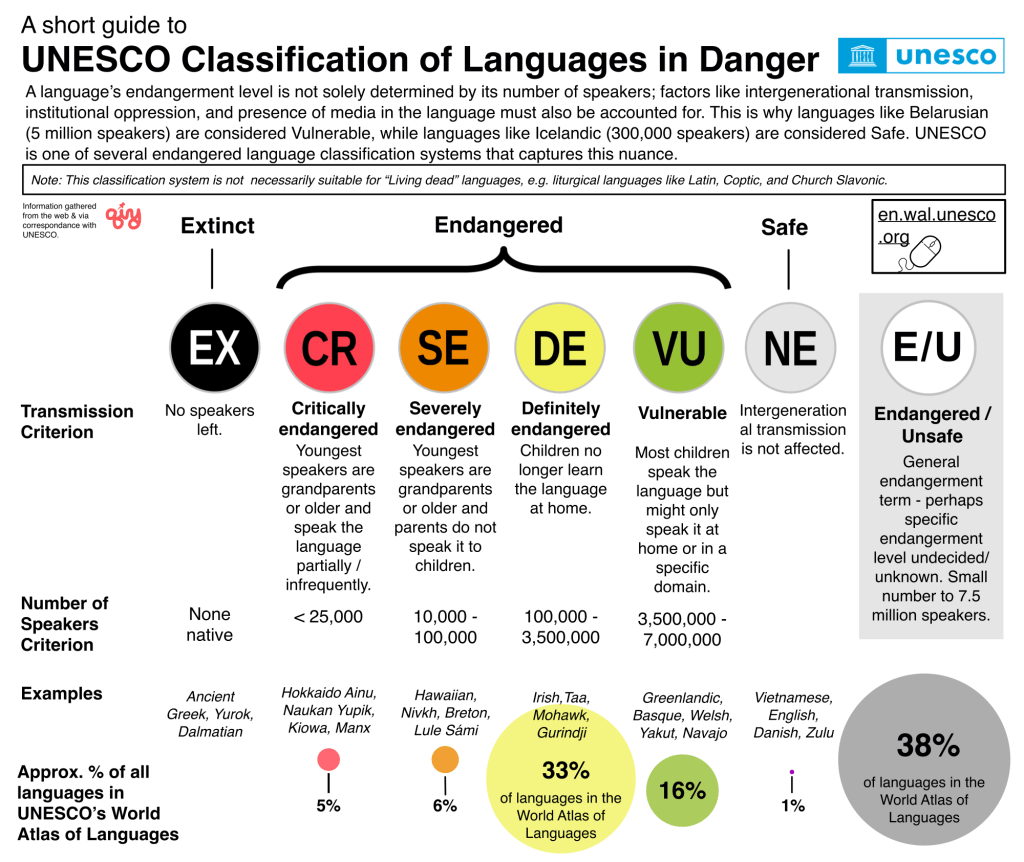
Download image/view full size here.
How many languages in the world are “endangered”? In linguistics classes, I’ve heard 80%, 90%, or even 95% – but by UNESCO’s definitions, it is over 99%. Out of 7,000 languages in their World Atlas of Languages, only 65 of them are deemed Safe, and the rest fall anywhere between Potentially Vulnerable to Critically Endangered. Even languages with a very large number of speakers, like Algerian Arabic (30 million+ speakers) are listed as Potentially Vulnerable. Meanwhile, some designations are more self-explanatory, like Hawaiian being Severely Endangered, as less than 1% of Hawaii speaks it proficiently.
In 2022, The Guardian’s Datablog published a list of Endangered languages using UNESCO standards. It claimed UNESCO used the following definitions:
Vulnerable – most children speak the language, but it may be restricted to certain domains (e.g., home)
Definitely endangered – children no longer learn the language as a ‘mother tongue’ in the home
Severely endangered – language is spoken by grandparents and older generations; while the parent generation may understand it, they do not speak it to children or among themselves
Critically endangered – the youngest speakers are grandparents and older, and they speak the language partially and infrequently
Extinct – there are no speakers left
However, this information is nowhere to be found on UNESCO’s World Atlas of Languages website – Why?
I discovered that in 2021, they rebranded their 2010 UNESCO World Atlas of Languages in Danger to The World Atlas of Languages (abbreviated as WAL) and launched a newer classification system. When you look at the online Atlas, you’ll see that the classification system is very similar to the previous one, but with a few differences:
Safe – ~1% of languages in their database
Potentially Vulnerable (As opposed to Vulnerable) – ~16% of languages in the database
Definitely Endangered – ~33% of languages in the database
Severely Endangered – ~6% of languages in the database
Critically Endangered – ~5% of languages in the database
Not in use (as opposed to “Extinct”)
Endangered/Unsafe (Not in former classification system) – ~38% of languages in the database
But where were the definitions?
Long story short, after some emails with the WAL, I learned that they’re still working on that part. For now, there seems to be a consideration of multiple factors: number of speakers, intergenerational transmission, presence of media in the language, and more. So while languages like Algerian Arabic are being actively transmitted and spoken on a large scale, to UNESCO, the lack of writing and media in the language is a cause for concern in this globalized world. I’ve also read about biases against “Maghrebi Arabic” varieties in the Middle East, North Africa, and Europe that may play a role in this designation.
All in all, I highly encourage you to explore UNESCO’s WAL and learn about one of the 7,000+ languages in the Atlas, especially the 99% of them that are deemed unsafe.
 qiy's linguistics world
Leave a comment