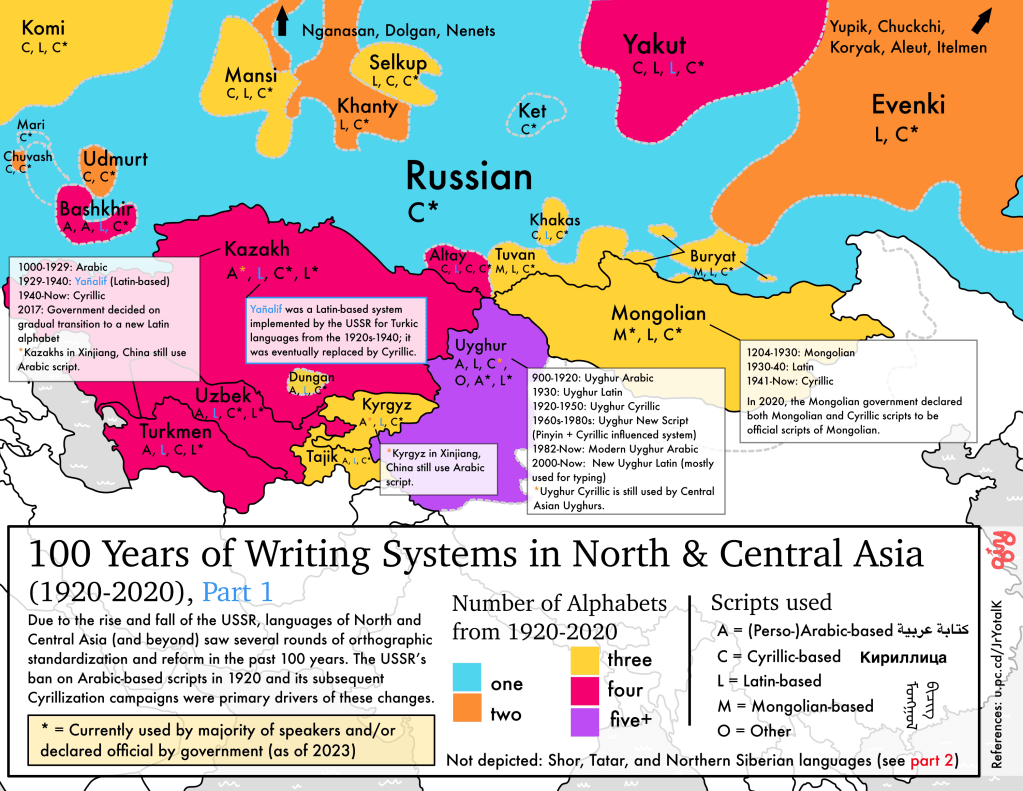
From 1920-2020, languages of North and Central Asia saw many writing system reforms, often abandoning Arabic- and Mongolian-based scripts in favor of Latin and Cyrillic-based ones.
Imagine the following: You’re halfway through your schooling, and one day, the government mandates all English to be written in Cyrillic – со лайк тыс (“so like this”). Then maybe a decade later, they change their minds and want the Latin alphabet back, but with one caveat: the words must be spelled with Polish spelling conventions. And when your children come along, they’re learning how to write English in the Arabic alphabet. That’s the experience of elderly Uyghur and Uzbek speakers who know three or four different ways of writing their languages (and often not of their volition).
So which main writing systems did this region’s languages switch between in the past 100 years?
- Mongolian
- Cyrillic
- Latin
- (Perso-)Arabic
How did this happen? Let’s run through some major orthography-related events of the past hundred years:
1920: The USSR banned Arabic-based scripts to suppress the spread of Islam.
1930’s: The USSR promoted Yañalif, a Latin-based writing system that would unify scripts of Turkic languages (e.g., Uzbek, Yakut); they also experimented with Latinization of non-Russian languages in general.
1950: Latinization was replaced with Cyrillization plans in order to promote Russian proficiency among all ethnicities under USSR’s jurisdiction.
2002: Following the collapse of the USSR, in the wake of minority languages of Russia taking on the Latin alphabet (e.g., Tatar), the Russian government mandated all languages to be written with the Cyrillic alphabet. This move was made particularly in response to Tatarstan’s plans for Tatar to switch to a Latin alphabet.
2000s-present: Languages of former USSR republics (e.g., Kazakh, Uzbek) have been transitioning to a Latin alphabet in order to distance themselves from Russia and/or to adapt a more widely used writing system.
As you can imagine, imposing a Slavic language’s writing system on the phonologies of Turkic (e.g., Uzbek), Mongolic (e.g., Mongolian), and Uralic (e.g., Mari) languages often proved to be a problem. This is why languages like Tatar still have language academies debating about Cyrillic transcriptions to this day. Some languages adapted throughout the decades, though: languages like Yakut added letters to their Cyrillic alphabet to accommodate sounds in their languages, and languages like Evenki kept the Russian alphabet despite the lack of correspondence between the orthographic representations and the pronunciations of the words.
All in all, one thing became clear: Under the USSR, there was an inherent desire for Russification, an ideology that led to suppression of non-Russian languages through a series of policies – not only through enforcement of Cyrillic alphabets, but also through bans on non-Russian languages from being taught in schools, execution of leaders and shamans of minority groups (e.g., Khanty chiefs and shamans), and forcing indigenous Siberian children into Russian language boarding schools. These events led to deaths and near-deaths of several indigenous Siberian and Central Asian languages and cultures. The tale of Soviet Asia’s orthographies is a tale of the rise and fall of the USSR and Russification ideology – and its languages are still experiencing the consequences of these events. In a future map, we will look closer into the languages and cultures of a pre-colonial Siberia.
References: http://u.pc.cd/JrYotalK
Note about inclusion of Xinjiang and Mongolia: I acknowledge that it is controversial to include Xinjiang and Mongolia as part of a map of “North and Central Asian” orthographies. I do not imply that those regions are part of North or Central Asia. I had multiple rationales for including them in the map, leading me to conclude that it felt wrong to not include them. Firstly, the Mongolian script – which was derived from an Old Uyghur script centuries ago – has been used by North Asia languages like Buryat and Tuvan prior to their Latinization / Cyrillization. Including Buryat and Tuvan but not Mongolian made the map feel incomplete. In addition, Mongolian has a similar history to Central Asian languages: the Mongolian People’s Republic was a satellite state of the USSR from 1929-1990, leading to USSR-backed writing reforms on Mongolian, such as Cyrillization.
As for Xinjiang, although Xinjiang was never under the USSR’s jurisdiction, many Uyghurs lived (and still live) in Central Asian countries. Additionally, linguists from the USSR assisted the People’s Republic of China in Cyrillicizing Uyghur in the ‘40s. Although China-USSR relations eventually dissolved in the ‘50s – thereby leading to a Uyghur New Script being adopted – Uyghurs residing in Central Asia still use a Cyrillic script. These massive writing system reforms witnessed by the Uyghur language is due to their being at the geographic, linguistic, and cultural crossroads of a USSR-ruled Central Asia and the People’s Republic of China. For this reason, Uyghur is also included in this map.

 qiy's linguistics world
Leave a comment